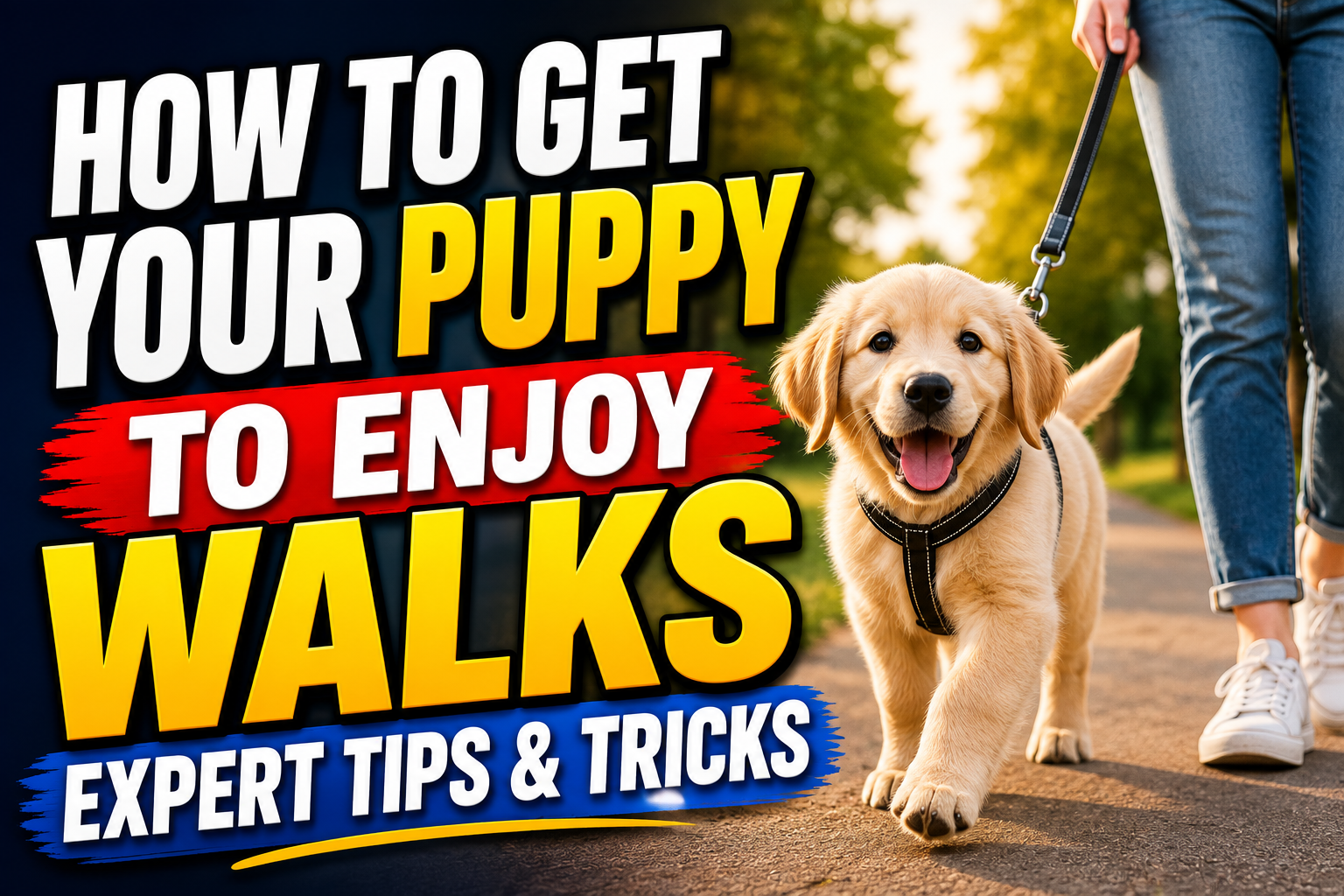
How to get your puppy to enjoy walks begins with making the activity safe, fun and simple. While your puppy may be very curious and active inside the house, that energy can quickly turn to fear or anxiety as soon as you clip on his leash. New sights, sounds, smells, traffic, people, other animals, and different surfaces can be overwhelming to a young dog.
The first step in teaching your puppy to walk on a leash is to not focus on how far you are going, but rather to help your puppy feel comfortable outside, learning that being with you means fun and exciting adventures. Once that step is achieved, you can begin teaching your puppy to walk calmly on a leash.
How To Get Your Puppy To Enjoy Walks
An easy way to create good walking experiences for yourself and your puppy is to incorporate one thing at a time. Begin with the use of the equipment and some basic practice inside and take it outside only when the time is right.
Start At Home
Let your puppy explore the harness and leash before attempting a proper walk. Try putting the harness on briefly and pairing it with something your puppy enjoys. Once they get used to it, put the leash on inside and practice taking a couple of steps.
Reward them for walking, sniffing, and exploring. VCA recommends that you start training in a quiet place where your dog does not have to contend with too many distractions before taking the dog out for the real thing.
Take It Outside
Make the outside walk a bit more challenging than the one you just took your pup through. Doing so lets them experience different terrains, and they will also learn to become familiar with busy areas without getting overwhelmed by traffic and large crowds of animals and people. Here’s a progression that you can follow:
- At home: Get comfortable with the harness and leash.
- At the doorstep: Let them explore the world beyond while you take it easy
- At a quiet, distant place: Explore new scents, sights, and sounds
- On an easy trail: Practice walking alongside one another
- Around some gentle distractions: Notice something interesting and come back to you
- On a busier trail: Add in a few extra challenges, but only if the pup is up to it.
There is no hard and fast rule about how much time should elapse before you progress to the next stage. If the pup is struggling, move back a step instead of pushing them too far.
Let Your Puppy Explore
The walks should not be all about training and discipline. Letting them sniff around gives your puppy a chance to familiarize themselves with the surroundings, and it can also be a reward for following you around.
Exploration breaks make walking a more enjoyable experience for them as well as you. Give them enough time to do their thing before asking for the next trick. That way you can make it a game of rewards because you have established the pattern that comes with a break.
Reward Good Behavior
Be on the lookout for all the things they do right because that is an excellent way to encourage positive behavior. The things they do are all worthy of praise and rewards. Dogs should understand that they can only keep going if they listen as they walk and pay attention to everything else around them.
Your puppy needs food, but you should also remember to reward them with playtime, toys, and activities they enjoy doing. The current recommendations in veterinary behavior training are for reward-based dog training. Rewarding moments include:
- Look up and come back to you
- Walk alongside you for a few steps
- Make loose leash walking a game
- Come to you after sniffing
- Move past something distracting
- Be patient and do not rush
Expert Tips & Tricks For Stress-Free Puppy Walks
Once the basics are covered, there are a few tricks that can help make those tough walks just a little bit easier. The most important thing is to focus on what you can do to change the situation, rather than what you’d like your small pup to do when faced with a distraction.
Create Distance
A distraction may be tolerable at one distance, but too close and it can cause chaos. Your pup may be able to walk by a dog two blocks away without incident, but see that same dog up close and they may begin barking or pulling.
Instead, work on creating more distance before asking them to focus on you again. When your puppy is able to tolerate a stimulus at a reasonable distance without pulling or barking, reward their calm behavior. VCA recommends redirecting your puppy so he doesn’t have the opportunity to react to his trigger.
Don’t Reinforce Pulling
Pulling often becomes a habit as it can get your pup what they want. If pulling gets your puppy to another dog, or a smelly patch of grass, or a new scent it will likely continue to happen,
VCA recommends avoiding a tug of war as soon as the leash tightens. Instead, stop or change directions when the leash tightens. Reward your puppy when the tension is released or their focus returns to you.
Handle Freezing Calmly
When a pup freezes up, look back to see what happened. A loud noise may have startled your puppy or a new object or slick patch of pavement may have been the culprit If your puppy seems frightened, give them space and time to recover.
Don’t force a nervous pup to approach anything that has frightened them If your puppy is refusing to walk or is stiff, sore or showing other signs of discomfort, contact with your veterinarian.
Avoid Forced Greetings
Not every dog needs to meet every other dog they see. Letting your puppy observe a fellow canine from a safe distance can be a great way to socialize them while letting them get used to the idea of other dogs.
AAHA recommends socializing pups so they are comfortable around people, animals and new things. Observation without the expectation of a meet and greet may be the way to do that. For a pup who becomes overly stimulated or excited around other dogs, learning to notice a dog and keep walking can be a valuable lesson, especially if it keeps them from lunging or barking.
End On A Positive Note
You don’t always need to walk until your puppy is exhausted. If you see your pup tolerating a new stimulus well, or they’ve handled a difficult walk and are still relatively relaxed it may be a good time to call it quits.
Your pup’s body is still physically developing, so strenuous activity should be avoided. VCA recommends leaving long jogs and challenging hikes to when they’re fully grown as those activities can place stress on their developing growth plates.
Signs of Progress
You may see signs of change before seeing a well-behaved dog on a leash. These behaviors can indicate that walks are becoming a pleasurable and relaxing part of your puppy’s daily routine
| What you notice | What it means |
|---|---|
| Looks back at you | Feels more connected |
| Recovers quickly | Handles surprises better |
| Sniffs calmly | Feels comfortable outside |
| Pulls less | Walking is getting easier |
| Passes dogs calmly | Manages distractions better |
I think that these behaviors are an improvement upon just simply walking your puppy, or dog.
When To Get Professional Help
Most puppy walking problems can be solved with patience and proper management. However, persistent fear, extreme reactions to people or other dogs, sudden refusal to walk, and apparent pain or limping should be brought to the attention of a veterinarian.
For behavioral issues that persist after consultation with a veterinary professional, dog walking training should be sought from a reward-based animal behavior professional.
When searching for a professional, it is important to ask about their methodology and avoid trainers who advocate against reward-based training. AVSAB recommends against the use of leash corrections, prong collars, choke chains, and e-collars.
Help Your Puppy Look Forward To Walks
Perfection in leash manners is not necessary for the puppy straight away; rather, the aim should be to have the puppy feel at ease out there and realize that it’s good to stay connected to you.
Make the walks manageable for the puppy, give rewards for appropriate actions, and keep the distractions away until the puppy is ready for them. If the whole activity becomes rewarding for your puppy, it will be much more eager to go on the next walk.
FAQ’s
When should I start the leash training?
Start by giving short but positive harness and leash training at home.
Why is my puppy ceasing walking?
Puppies might refuse to walk due to fear, fatigue, distractions, or unfamiliar environment.
Should my puppy greet all dogs?
No, learning how to walk past other dogs calmly is important as well
How long should I walk my puppy?
The walks should be short and only last as long as your puppy enjoys them, taking into consideration their age, health status, and level of activity.
References

- 9 Best Dog Life Vests of 2026: Reviews & Buyer’s Guide - September 15, 2026
- Silky Terrier: Complete Breed Guide, Personality, Care & Training - September 10, 2026
- Miniature Poodle: Complete Breed Guide, Personality, Care & Training - September 10, 2026