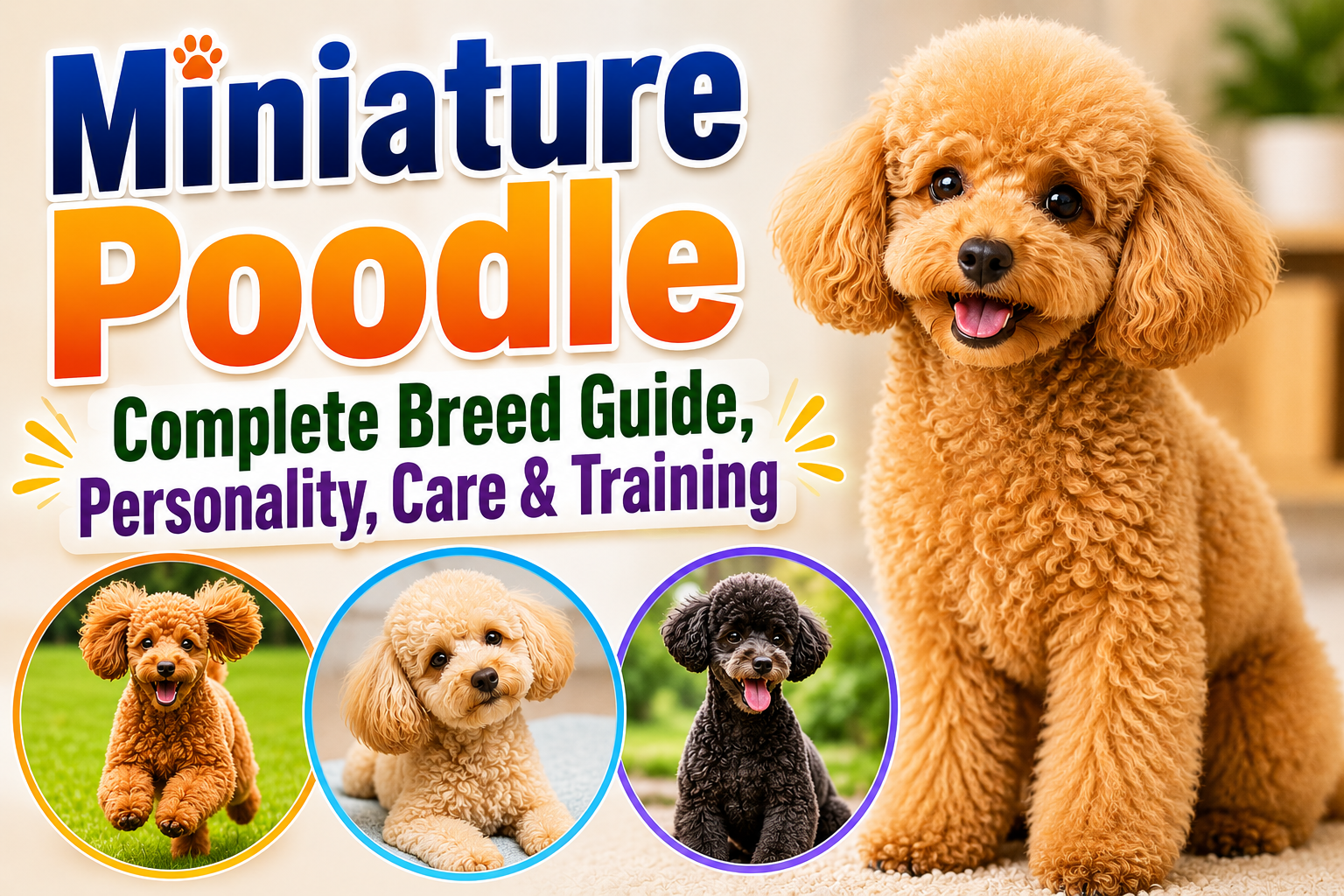
The Miniature Poodle is an active and smart breed of dog with affectionate behavior towards his family members, along with a curled hair coat that demands regular care. Although this dog’s small build makes him appropriate for most households, he is not a breed of dog that can be kept easily without proper attention and care.
What Makes The Miniature Poodle Different?
The Miniature Poodle is one of the 3 Poodle breeds, along with the Standard and Toy. According to the breed standard, it has a height between over 10 but no more than 15 inches from shoulder to floor.
While the miniature poodle’s well-groomed image is linked to pets, the Poodle was historically used as a water retriever. This breed requires people to engage it in athletic, intelligent, and coordinated activities, as its working capabilities are closely tied to these traits.
While the smaller size is easier to handle in an apartment, it does not mean that the Miniature Poodle is less demanding in terms of exercise. This dog breed can adapt to living in an apartment with a person if the owner can provide it with the opportunity to go outside, explore, play, be trained, and rest.
Complete Breed Guide: Understanding Miniature Poodle Breed Beyond Its Appearance
The Miniature Poodle’s coat may be the first thing that catches one’s eye, but his intellect is actually the most valuable in day-to-day life. This breed picks up on household habits and even identifies patterns well before the owner does.
Their cleverness can be directed towards retrieving, scent games, training sessions, food puzzles, and much more. Left without something to occupy their brainpower, some may find other ways to keep themselves amused, such as barking excessively, demanding lots of attention, and searching constantly for more to do. As such, the Miniature Poodle is best suited for people who want to engage their dog in a more active role rather than a passive lapdog type of lifestyle.
Personality & Temperament: How Miniature Poodles Behave At Home
Miniature Poodles are often very attached to their owners. Some are constantly at their heels, while others are more likely to curl up on the couch in a particular spot. They can be very loving and caring, though each has its own opinion on how much love it should receive in return. However, the amount of physical affection each one wants is somewhat different.
This can lead to confusing situations in which the pet becomes more demanding or capricious if, for example, jumping is sometimes ignored or barking does not get the desired reaction when looking out the window
At the same time, early socialization is a must for this breed. Thus, a puppy needs to be introduced to unfamiliar surroundings, people, transportation, noise, grooming, other animals, and much more. It is necessary in a balanced way so as not to traumatize the pup.
Exercise & Mental Stimulation: Keeping A Miniature Poodle Fulfilled
A Miniature Poodle needs to have both body and brain exercise. The walk will give your dog the needed exercise, and the sniffing around will give him something to think about. You can also try retrieving, scent games, food puzzles, interactive play, and short training sessions to help them.
Helpful Activities For A Miniature Poodle
| Activity | Main benefit |
|---|---|
| Sniffing walks | Exploration |
| Retrieving | Purposeful movement |
| Scent games | Concentration |
| Trick training | Learning |
| Food puzzles | Problem-solving |
| Interactive play | Engagement |
Puppies require special attention because they can get too excited to be good for their body to handle. Their activity should be age- and development-appropriate and not necessarily depending on how active the puppy is.
Not every lively Miniature Poodle requires extra activity. Times for quietness, consistent sleeping spots, and praise for being calm help the dog understand that relaxation is a part of life.
Training: Turning Intelligence Into Reliable Everyday Behavior
Miniature Poodles are usually fast learners, although fast learning is not synonymous with consistent behavior. A dog that reacts perfectly at home may have difficulty dealing with another dog, an unfamiliar person, bike, or a new smell.
The training needs to be geared towards beneficial behaviors like recall, walking on leash, waiting at the door, settling down, leaving potentially dangerous items alone, proper greeting, and cooperative handling.
Positive reinforcement will give the dog an incentive to repeat desirable behavior. Food, playing, praise, toys, and any other forms of reinforcement can be used. The prevention of undesirable behavior being practiced over time is just as crucial.
Coat Care & Grooming: Managing The Miniature Poodle’s Curls
The Miniature Poodles’ coat sheds minimally; however, it is not hypoallergenic. The coat can become matted and tangled if you do not brush it properly.
Many owners of companion dogs get their small poodles’ hair clipped short to make grooming easier. On the other hand, longer coats need more attention and are brushed regularly. In addition, you have to take your pet to a professional groomer once every four to six weeks, and it depends on how long the cut is.
Essential Grooming Tasks
| Task | Purpose |
|---|---|
| Brushing | Prevents tangles |
| Combing | Checks the coat |
| Clipping | Controls length |
| Nail care | Maintains comfort |
| Ear checks | Spots changes |
| Dental care | Supports oral health |
Grooming needs to be introduced in a gentle manner when the dog is still young. Gentle exposure to brush, clipping of paws, bath, dryer, and clippers will make the process easier in the future.
Feeding & Body Condition: Keeping A Miniature Poodle Healthy
A Miniature Poodle needs a properly balanced diet that takes into account the dog’s age, level of activity, and body condition. The directions on the package are a good guideline, but it is important to look at your dog’s body condition to ensure you are not underfeeding or overfeeding the animal.
It is also important to note that treats can be a big part of a dog’s diet. Since these dogs can be trained so easily with food, many people end up giving their pets too many treats and lots of calories without realizing it. To combat this, it is important to limit treat sizes and keep track of them in the daily diet.
Always make sure fresh water is available for the pet, and if there are any special dietary requirements due to medical issues, a vet should be consulted.
Health & Veterinary Care: What Owners Should Know
Miniature Poodles may have a good lifespan, but a responsible breeder must test the puppies for a number of inheritable conditions. Recommendations include patella test, hip examination, ophthalmologist examination, and test for progressive retinal atrophy in PRCD form.
Health problems found in the breed may include luxated patella, hip dysplasia, hereditary eye problems, Legg-Calvé-Perthes disease, epilepsy, and teeth problems. However, these health problems do not have to occur and may be rare.
Breeding risk factors can be decreased with health screenings; however, health screenings do not ensure that your dog will be free from disease. Veterinarian visits are crucial all throughout a dog’s life. help lower the chances of producing puppies with health problems, but cannot guarantee disease-free dog. Health care is important throughout the lifetime of your pet.
Choosing A Miniature Poodle: Finding A Healthy, Suitable Puppy
A responsible breeder will talk about health testing, temperament, puppy development, socialization, grooming, and veterinary care. The buyer should be able to check independently the results of the tests recommended by the breeder and not rely solely on his assurances about the parents’ health.
The breeder should not base the sale on the puppy’s appearance, unusual size, colors, or nice pictures. All this is less important than screening and honest conversation about the health and temperament of the parents and puppies.
The best questions to ask are probably the following:
- What health tests have been done on both parents?
- Are the results of these tests available for review?
- What are their temperaments like?
- How have they been socialized?
- Have they been groomed or handled?
- What veterinary care has been provided?
- What kind of support do they offer after you bring the puppy home?
Living With Children & Other Dogs: Making The Household Work
A Miniature Poodle could be a wonderful addition to your family, but it is important to consider that each individual animal’s temperament is unique and should be respected. Kids must not chase, grab, corner, or bother the dog in any way, especially during eating or resting.
Due to their smaller size, it is especially important not to engage in overly rough activity with it, as it can result in injury. With other animals, it is best to introduce them slowly and carefully, provide separate feeding areas, play areas, and a safe space for each animal to retreat to when they feel threatened, injured, or annoyed.
Is A Miniature Poodle Right For Your Lifestyle?
The Miniature Poodle is a good choice for those who want a small and highly interactive dog. Its small size is convenient, but it does not reduce the responsibility of caring for the pet. One has to consider regular grooming, exercising, training, socialization, mental stimulation, and access to a veterinarian.
This breed is not suitable for people who want a small dog that does not need much grooming, training, and interaction. The intelligence of this animal is an advantage, but only when the owner can adequately control and direct the cleverness of the Miniature Poodle.
Living With A Miniature Poodle
A Miniature Poodle will quickly become part of the household, learning the routine and how they can assist to lighten the load. While the breed’s intelligence is one of its best qualities, it also means that consistency is required in terms of training, as well as grooming and mental stimulation.
The breed is best suited to those who want a more interactive dog that will not be content with sitting on the couch, but rather a companion that is athletic and intelligent, with the willingness to participate in all manner of activities the family gets up to, and the commitment required to keep it exercised and clean.
FAQ’s
How big does a miniature poodle get?
A Miniature Poodle is over 10 inches tall, but not over 15 inches in height.
Do miniature poodles shed?
They are non-shedding, but the tight curls of their coats should be brushed regularly to avoid matting.
How often does a miniature poodle need to be groomed?
Most owners take their miniature poodle to the groomer every four to six weeks. They also require frequent brushing in between visits.
Are miniature poodles easy to train?
Yes. They are intelligent dogs and are generally trainable.
Can a Miniature Poodle live comfortably in an apartment?
Yes. Their compact size makes them well-suited for apartment living, provided their daily exercise and mental stimulation needs are met through walks, interactive play, and training.
References
Disclaimer: Each Miniature Poodle has its own needs, personality, and medical requirements. The information in this article is offered as general reference only. It is important that you consult with your personal veterinarian regarding any medical concerns or questions about your dog’s behavior, rather than relying on information from this article.

- 9 Best Dog Life Vests of 2026: Reviews & Buyer’s Guide - September 15, 2026
- Silky Terrier: Complete Breed Guide, Personality, Care & Training - September 10, 2026
- Miniature Poodle: Complete Breed Guide, Personality, Care & Training - September 10, 2026