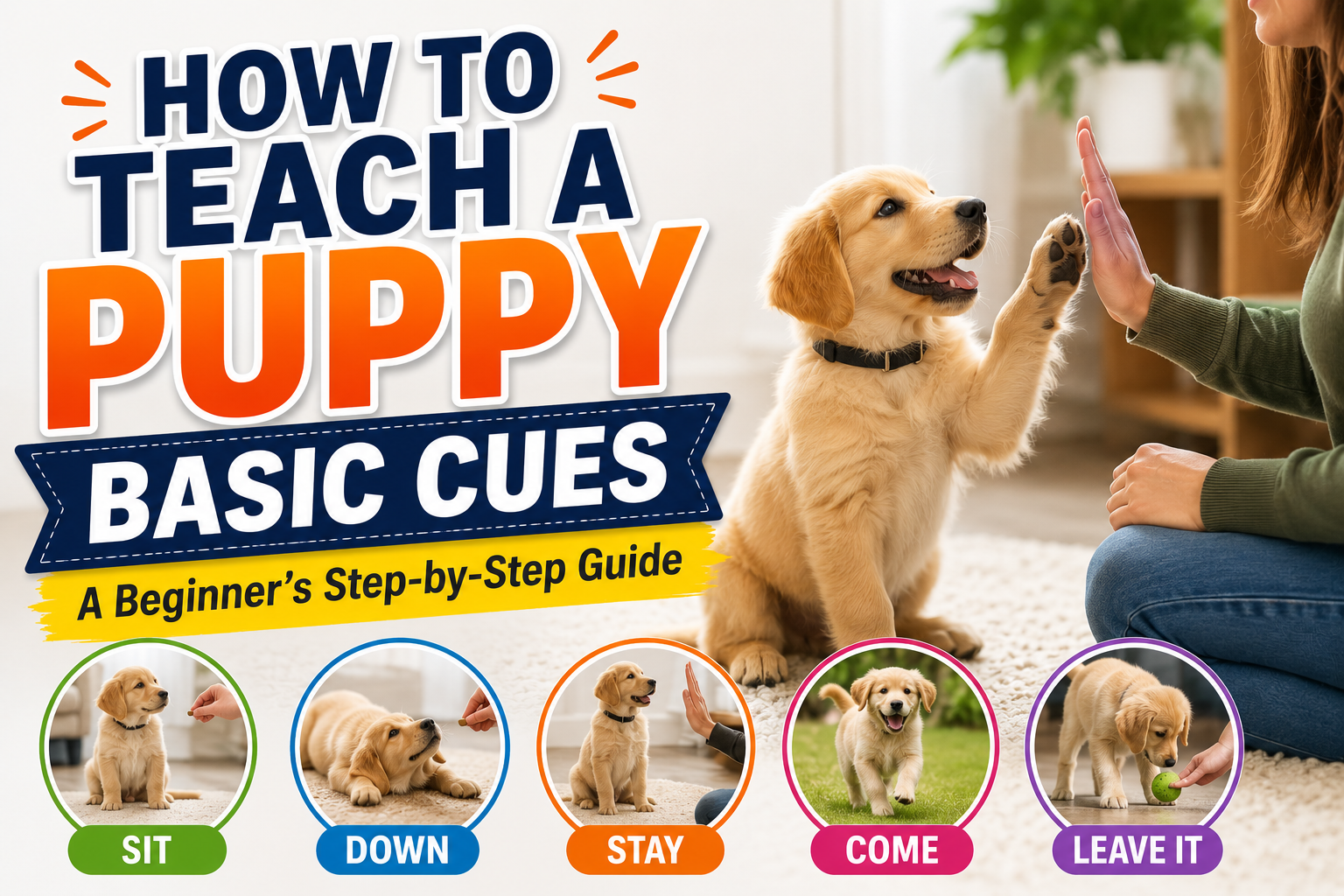
How to teach a puppy basic cues requires a lot of consistency, patience and positive reinforcement. It is best to teach your puppy some basic commands as they will learn to know what is expected of them, and be safer as well. Instead of aiming for perfect obedience, focus on short, enjoyable sessions that build lifelong habits.
Why Basic Cues Matter
Basic cues guide puppies to deal with their daily surroundings with ease. It will be easier to control a puppy that has been taught to sit before meeting people, come on command, and stand by the door. Puppies get mental stimulation from early training, which helps them to learn how to control themselves.
Essential Tools and Rewards for Puppy Training
Gather these basic items before you begin to make training easier and more fun for your puppy:
- High-Value Treats: Soft, tiny pieces of boiled chicken or cheese that your puppy can swallow quickly without losing focus.
- Marker Word or Clicker: A crisp word like “Yes!” or a clicker to mark the exact moment your puppy does the right thing.
- Treat Pouch: A clip-on pouch to deliver rewards in a second or two.
- Fixed Leash & Harness: A 6-foot standard leash and a padded harness to safely guide your puppy without pulling on their neck.
Essential Cues To Teach First
| Cue | Purpose |
|---|---|
| Sit | Encourages calm behaviour |
| Come | Builds reliable recall |
| Stay | Improves self-control |
| Down | Helps your puppy settle |
| Leave it | Prevents unsafe choices |
| Drop it | Releases objects safely |
How To Teach A Puppy Basic Cues
Start training in an environment where there is little noise and your puppy can concentrate. Have some small rewards at hand and keep the duration of each session to a minimum. Remember, puppies learn better through multiple short sessions than through one big session.
Say each cue only once, and always follow it with a reward for the desired action. It is easier for puppies to ignore cues when they are said multiple times. One more helpful piece of advice would be to perform the same cue in a number of places, since dogs do not automatically generalize learned behaviours.
Teach “Sit”
Place the treat close to your puppy’s nose and slowly lift it up and backwards. As they track the treat, they will automatically sit. Praise and reward instantly. When your dog gets used to the gesture, say “Sit” prior to giving the hand signal.
Teach “Come”
Stay at some distance, happily call your puppy’s name with “Come,” and be lavish with rewards when they come to you. For better recall, sometimes call your puppy while they are playing, give them rewards and let them play again. This way, they would learn that coming to you is not an end to their game but a good thing.
Teach “Stay”
Ask your puppy to sit down, extend your arm to give a stop sign, and then tell him quietly, “Stay.” Praise your puppy after a second or two if he stays in the same spot. You can gradually extend the time before moving on to increasing the distance or adding distractions. Practise these cues daily and keep every session positive. Building a strong foundation with these first commands will make introducing more advanced cues much easier.
A Beginner’s Step-by-Step Guide to Everyday Training
Once your puppy is responding consistently to Sit, Come, and Stay, teach him only one new cue at a time, while practicing the fundamentals. Doing things this way ensures that your puppy will not get confused and builds his confidence along the way.
Teach “Down”
Begin by having your puppy sitting. Slowly move the treat from its nose to the ground in front of it. The puppy will automatically go into the lying down position while following the treat. Immediately reward then begin adding the verbal cue “Down” after several successful repetitions.
Teach “Leave it”
Put the treat in your closed fist and allow your puppy to explore it. When he stops sniffing or scratching your hand, praise him and give him another treat. Once your dog learns how to do this, you can teach him the cue “Leave it”. This cue comes in handy when your puppy tries to grab unsafe objects.
Teach “Drop it”
Present a toy for your puppy, but place the treat close to its nose. While it drops the toy, command “Drop it,” give it the treat, and give it the toy again. It will help your puppy understand that releasing the toy does not necessarily mean that the game is over, making the cue easier to reinforce.
Common Training Mistakes To Avoid
| Mistake | Better approach |
|---|---|
| Repeating cues | Say the cue once |
| Long training sessions | Maintain short training sessions |
| Delayed rewards | Give reward right away |
| Rushing progress | Gradually increase challenge |
| Inconsistent words | Use consistent cues |
Build Good Habits Every Day
The most well-trained puppies do their training in day-to-day activities rather than actual training sessions. Request a sit before mealtime, a stay before opening a door, or a come command before putting the collar on them. Such simple instances of training are done without additional effort.
As the puppy gets better, train them at different places and add distractions gradually. In case the puppy finds it difficult to work in the new environment, it is all about making the task simpler. Regular practice and positive reinforcement will help your puppy respond reliably wherever you go.
Better Training Begins With Consistent Practice
Training your puppy the basic cues will have to do more with making habits for life than getting quick results. Each short but positive training session will help you teach your puppy what is expected from them, while at the same time improving the communication between you. Focus on just one cue at a time, make sure that the right behavior gets rewarded straight away, and practice in different environments.
Bear in mind that perfection is not always possible, and sometimes you may experience set-backs which are part and parcel of learning. With persistence, repetition and positive reinforcement, those cues which are so simple to give today will transform into reliable behaviors tomorrow.
The time that you put into it will help make all your daily activities from walking, going to the veterinarian to meeting people a lot easier and more fun for both you and your puppy, creating a strong foundation for a happy, well-mannered companion.
FAQ’s
When should I start training puppy cues?
Most puppies are able to learn simple cues as early as 8 weeks with short positive sessions.
Why doesn’t my puppy listen to the cues outdoors?
Puppies must be trained under various conditions since there is always the possibility that distractions might interfere with learned cues.
How frequently should I train my puppy?
Short 3-5 minute training sessions several times a day have proven to work better than prolonged training sessions.
What do I do if my puppy stops responding?
Reduce distractions, simplify the cue and reward the puppy whenever he responds correctly.
Disclaimer: This article is for general educational purposes only and does not serve as a replacement for professional advice from a veterinarian or a certified dog trainer. In case your puppy is experiencing behavior problems, fear, aggression, or training troubles, seek the help of a professional.

- Puppy Harness Guide: How to Choose the Right Dog Harness for Training - September 20, 2026
- Best Chow Chow Mix Breeds: Traits, Size & Temperament Guide - September 10, 2026
- Entlebucher Mountain Dog: Complete Breed Guide, Care & Training - September 10, 2026