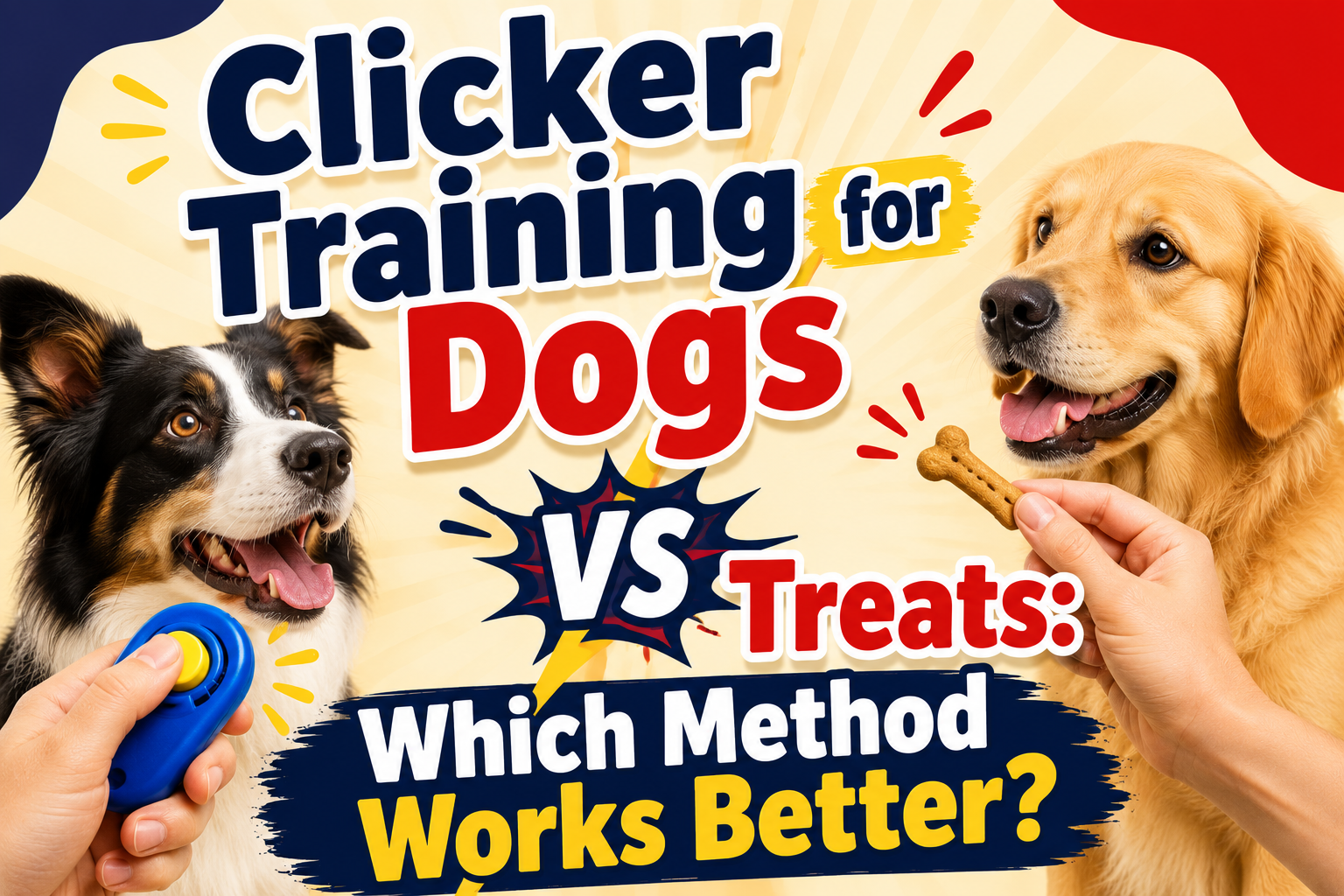
Clicker Training for Dogs vs Treats: A dog’s successful training requires much more than command training. This includes establishing communication, fostering a trusting relationship, and allowing your dog to realize what kind of behavior will result in good things happening.
Out of all of the possible forms of training for dogs that exist at present, clicker training and treat training are the most common types. Both types use positive reinforcement as their training style, one that is favored by veterinary behavioral specialists and dog trainers alike.
The problem that many dog owners think about whether they should choose either clickers or treats for their dogs is commonly misinterpreted. Actually, the clicker and the treat have different purposes in training. While one serves as a means of communication, the other functions as a reward. This is where the understanding of the two should start.
How Dogs Learn
Dogs respond through consequences. A behavior will become reinforced by positive things if it happens consistently, making the dog more prone to perform such behavior. This idea is called positive reinforcement and is the basis of modern dog training.

Build trust faster with our Training a Rescue Dog guide.
For example, if the dog sits and receives a reward right away after doing that, it creates a connection between sitting and a positive experience. As a result, the behavior will become more stable. The difficulty for the trainers is in making sure the dog knows what exactly he did that received a reward.
What Is Clicker Training?
The clicker training uses a small hand-held device that emits an audible clicking sound. The click works as a marker signal for telling the dog the exact time at which it has exhibited the wanted behavior. Clicking does not work as the actual reward but rather serves as a signal of the coming reward.
Being immediate, clicking helps avoid confusion. Usually, dogs do multiple things in just seconds and exact timing makes all the difference in training speed. Clicking catches the wanted behavior precisely.
For example, when training a dog to lay down, the click can take place the moment the dog’s elbows make contact with the ground. This precise timing makes it clear to the dog what he is being rewarded for.
Benefits of Clicker Training
- Marks the specific behavior that is to be rewarded.
- Helps improve communication between dog and trainer.
- Faster results for teaching difficult behaviors.
- Provides consistent reinforcement each time.
- Effective for distance training.
- Effective for agility, obedience, and tricks training.
What is Treat-Based Training?
The treat training relies on rewarding the dog by means of using food rewards. In case a dog responds to a particular command properly, he gets a treat right after that. Being a very powerful motivator for many dogs, treats can be among the quickest ways to train the dog.
It is very common among new dog owners due to its simplicity. Many puppies and adult dogs respond very well to food rewards, which makes the training process more productive and enjoyable.
Treat-based training is commonly used for:
- Sit
- Stay
- Down
- Recall
- House training
- Crate training
- Leash manners
- Socialization exercises
For many household pets, treats alone can be enough to teach excellent manners and basic obedience skills.
Train smarter with the Best Dog Training Tools for faster results.
Clicker Training vs Treats: A Comparison
| Feature | Clicker Training | Treat Training |
| Primary Purpose | Marks behavior | Rewards behavior |
| Precision | Very High | Moderate |
| Equipment Needed | Clicker and rewards | Rewards only |
| Beginner Friendly | Requires practice | Easy to start |
| Basic Obedience | Excellent | Excellent |
| Advanced Training | Excellent | Good |
| Distance Training | Strong | Limited |
The above comparison shows why many trainers avoid treating the 2 methods as competitors. They solve different training challenges and often work best together.
Which Training Method Helps Dogs Learn Faster?
For simple actions like “sit” and “stay,” food alone may serve the purpose very well because most dogs are motivated by food and thus, the use of reinforcement can help to build the habit of doing the desired behavior easily.
A clicker serves as an instrument that instantly informs a dog about the exact behavior that is rewarded. This precision often leads to faster learning when teaching complex behaviors, advanced obedience exercises, or tricks that require multiple steps.
For example, a trainer teaching a dog to spin might reward:
- Looking toward the target.
- Turning its head.
- Taking the first step.
- Making half a turn
- Making a full spin.
A clicker makes it easier to identify each successful step, helping the dog progress more efficiently.
Which Training Method Is Better For Puppies?
In most cases, treats prove to be the easiest way to start training for puppies. Puppies are naturally very motivated by food, and as such, they usually respond well to rewards. Training skills such as crate training, potty training, and teaching names are all achieved through the use of treats alone.
As your puppy gets more confident and starts learning new things, the introduction of a clicker becomes necessary for better communication. Professional trainers use clickers along with treats as part of their training process.
Understand It With Example: Recall Training
This form of training provides an example of how both methods can be used together. Think about a scenario where your dog is in the backyard and you call its name.
The sequence of recall training may involve the following steps:
1. You call your dog.
2. Your dog turns towards you.
3. You click right away.
4. Your dog comes back to you.
5. You give it a treat.
In the above example, the click is an indication of making the choice to respond to the recall command, while the reward is a positive reinforcement for such behavior.
Common Training Mistakes to Avoid
Even the most effective training tool will not produce desired results if not applied properly. Most training problems usually stem from wrong timing or lack of proper communication.
Some common mistakes include:
- Clicking without rewarding.
- Showing treats before issuing an order.
- Providing a reward after several seconds have passed.
- Using treats as a way to bribe.
- Training for too long at a time without pauses.
If you avoid these common training mistakes, your pet’s training will become more successful whatever the method you use.
What Is Recommended By Professional Trainers?
Most professional trainers give less attention to the choice between clickers and treats, and more to the proper application of positive reinforcement. The majority of modern training programs utilize different forms of rewards, such as food, praises, toys, or rewards that involve access to walks or games.
Teach fun commands with these Easy Tricks to Teach Your Dog.
Many trainers prefer clickers as they allow establishing precise communication. However, the majority of them still use treats since they are some of the most powerful motivators. Such combination allows the trainer to communicate precisely while keeping the dog interested in the training.
Professional organizations like the American Kennel Club, the Association of Professional Dog Trainers, and veterinarians strongly recommend reward training since it promote learning while building up a strong bond between the dog and its owner.
Things to Remember on Clicker Training for Dogs vs Treats
While comparing Clicker Training for Dogs vs Treats, it is important to understand that these 2 methods play different roles.
- Clickers highlight the behavior.
- Clickers increase accuracy.
- Treats increase motivation.
- Treats reward behavior
- Positive reinforcement is achieved through both methods.
- Both of these methods are widely used by professionals in combination.
Understanding Clicker Training vs Treats can help you create a training approach that suits your dog’s personality and learning style.
The Real Key to Successful Dog Training
There is no simple answer to the question of Clicker Training for Dogs vs Treats, as both of the approaches bring their contribution into achieving effective dog training. It is treats which motivate dogs and make them want to perform specific actions, whereas it is a clicker that allows giving clear communication and indicating precisely what action the dog performed well.
For teaching basic obedience, sometimes treats can be enough. When it comes to teaching advanced skills and using clear communication, there are certain benefits of using a clicker. In many cases, the combination of both methods works best, providing dogs with clear instructions and meaningful rewards. The key is being consistent and patient in training.
Stop unwanted barking with our How to Stop Your Puppy Barking guide.
FAQs
Which method is better, clicker training or treat training?
Both are not always better than the other. Clickers offer exact feedback while treats give motivation. Most trainers usually combine the 2 methods.
Is it possible to train without a clicker?
Yes. It is possible to teach your dog without a clicker using treats, praise, and reinforcement alone.
When do I stop using treats?
As your dog learns more reliably, treats can be used less often alongside praise and sometimes rewards.
Are all dogs fit for clickers?
Clickers work perfectly fine with most dogs, although some might perform equally as well with a verbal marker such as “Yes.”
What should I do if the clicker sound scares my dog?
Some dogs are sensitive to loud noises. If your dog gets scared, you can muffle the sound by putting the clicker inside your pocket or wrapping it in a towel. You can also switch to a softer clicking device or just use a happy verbal marker like “Yes” instead.
Disclaimer: The content on this page is for informational use only. For personalized advice regarding your pet’s health, always seek guidance from a certified veterinarian.
Sources
- American Kennel Club (AKC)
- Association of Professional Dog Trainers (APDT) Association of Professional Dog Trainers
- American Veterinary Medical Association (AVMA)
- Humane World for Animals Wikipedia

- Puppy Harness Guide: How to Choose the Right Dog Harness for Training - September 20, 2026
- Best Chow Chow Mix Breeds: Traits, Size & Temperament Guide - September 10, 2026
- Entlebucher Mountain Dog: Complete Breed Guide, Care & Training - September 10, 2026